Buyer's Field Notes
The Shipment Passed Inspection. That Does Not Mean Every Piece Passed.
A lot-acceptance decision and a count of all defective pieces are different things. Buyers need to settle that distinction before an inspection report becomes a release instruction.
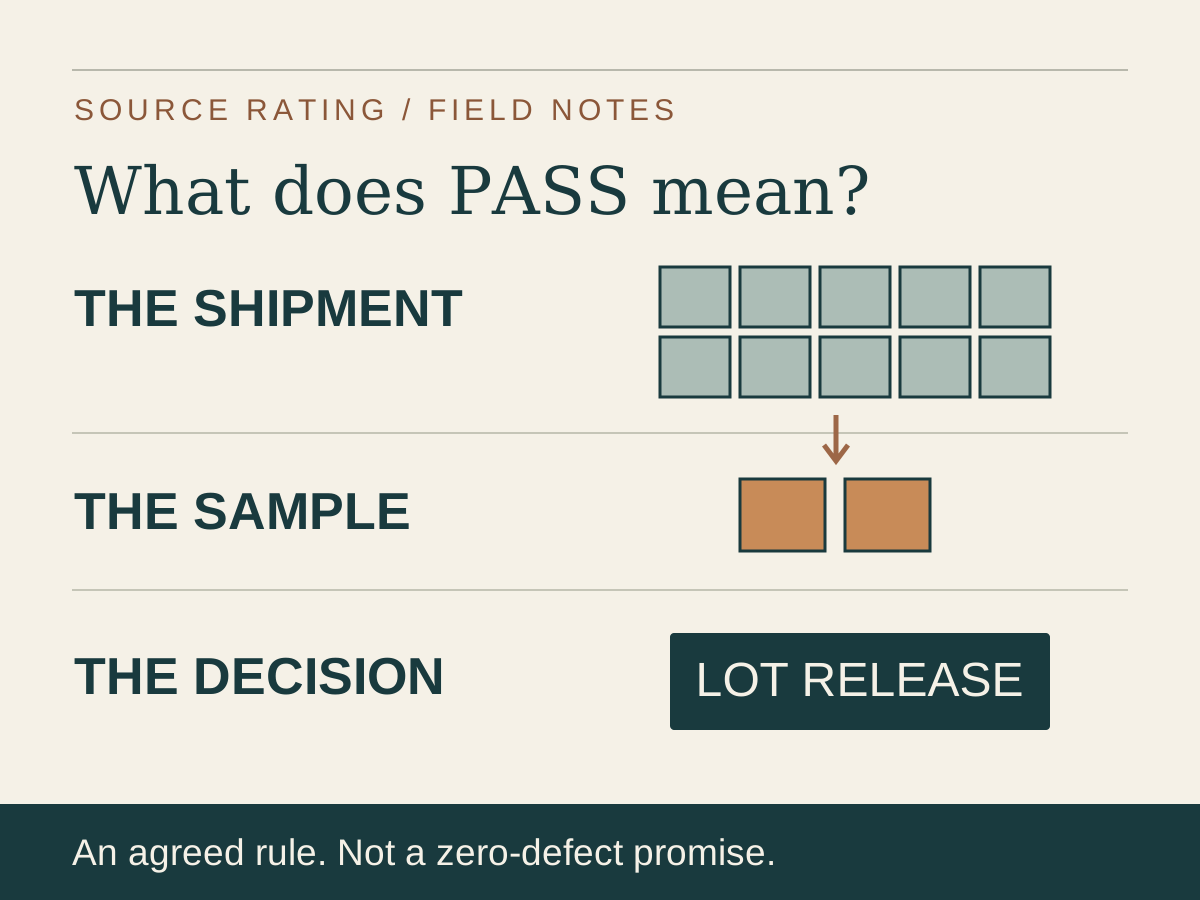
The most consequential word in a pre-shipment inspection report may be the shortest: pass. A purchasing manager can read it as permission to release payment. A warehouse can read it as confirmation that every box is sound. An inspector may mean something much narrower: the observations met the acceptance rule for the sample examined.
Those interpretations need to be reconciled before the goods leave the factory. Otherwise the first defective piece found on arrival can turn a technically valid inspection into an argument about a promise nobody actually made.
A decision about a lot, not a census of its defects
The NIST engineering statistics handbook draws a useful distinction: acceptance sampling is primarily intended to support acceptance or rejection of a lot, rather than estimate its precise quality. A sample is selected from the lot and assessed against a specified plan. That procedure is not the same as inspecting every item.
Consequently, a passed sample does not establish that the shipment contains no defects. Nor should the percentage found in a small sample be presented as an exact count for the unexamined goods. These are different claims, requiring different evidence. The inspection report should state which claim its work supports.
NIST also explains the trade-off through an operating-characteristic curve: a sampling plan has different probabilities of accepting lots at different underlying defect levels. Producer's and consumer's risks are part of choosing the plan. The practical lesson is not that sampling is unreliable. It is that sampling involves agreed decision risks, not a promise of certainty.
The inspector needs more than an AQL number
An RFQ that says only 'AQL inspection required' leaves important purchasing decisions unresolved. Which lot does the inspection cover? Which characteristics are checked? How are defects classified? Who selects the sample? What happens after rejection? NIST's description of a single sampling plan makes clear that sample size and the acceptance number are specific parts of the plan. A headline quality level is not the complete instruction.
For an industrial order, start by identifying the goods the decision will release. A shipment containing several product types, manufacturing batches or revisions should not silently become one undifferentiated inspection population. Ask the quality professional responsible for the plan to explain how those differences are treated. This is a procurement question about coverage, not a recommendation to select a particular sample size from this article.
Next, describe defects in terms that the factory, inspector and receiving team can apply consistently. A scratch that is tolerable on hidden packaging is not automatically tolerable on a sealing surface. A dimension measured against an obsolete drawing is not a useful pass for the current revision. Record the requirement, its reference and the classification before inspectors are looking at a finished batch and negotiating what counts.
Release instructions should preserve the limits
A useful report links its lot identity to the packing list, names the inspected characteristics, identifies the applicable plan and records what the sample actually contained. The release decision should also carry forward unresolved deviations, agreed concessions and any checks outside the inspection scope. An inspection of appearance does not silently become a functional test.
Consider asking for release wording such as: 'Lot accepted under the agreed sampling plan for the listed characteristics; outstanding exceptions are recorded separately.' This is suggested buyer-side wording, not a quotation from a standard. It communicates substantially more than a green pass box without pretending to guarantee each uninspected piece.
Define the rejection route as well. A failed lot may require segregation, corrective work and a properly agreed reinspection. Simply replacing the visibly bad sample pieces and asking the inspector to look again should not be an unrecorded shortcut. What happens next belongs in the inspection arrangement, not in an improvised conversation at the loading bay.
Sampling is useful precisely because inspecting everything can be impractical, expensive or destructive. Keep that advantage, but do not ask the report to say more than the work performed. Before approving dispatch, ask one final question: does everyone understand the same meaning of pass?
For the wider release record, read our pre-shipment inspection guide.
Reading notes
Source notes
Official NIST explanatory guidance checked on 21 October 2026. These sources explain statistical principles; they do not select a project sampling plan or replace the contractually adopted inspection standard.
NIST/SEMATECH Engineering Statistics Handbook
Purpose and limits of lot acceptance sampling, including the distinction from estimating lot quality.
NIST/SEMATECH Engineering Statistics Handbook
Explains sample size and acceptance number. Historical examples are not a recommendation to adopt an obsolete standard.
NIST/SEMATECH Engineering Statistics Handbook
Explains acceptance probabilities and producer/consumer risk. No example numerical plan is reproduced or prescribed here.
Continue the decision