Buyer's Field Notes
Before Comparing Carbon Numbers, Read the Denominator
Two environmental declarations can be legitimate without supporting the comparison in a bid spreadsheet. Start with the product's function, the reference unit and the life-cycle boundary—not the smaller headline number.
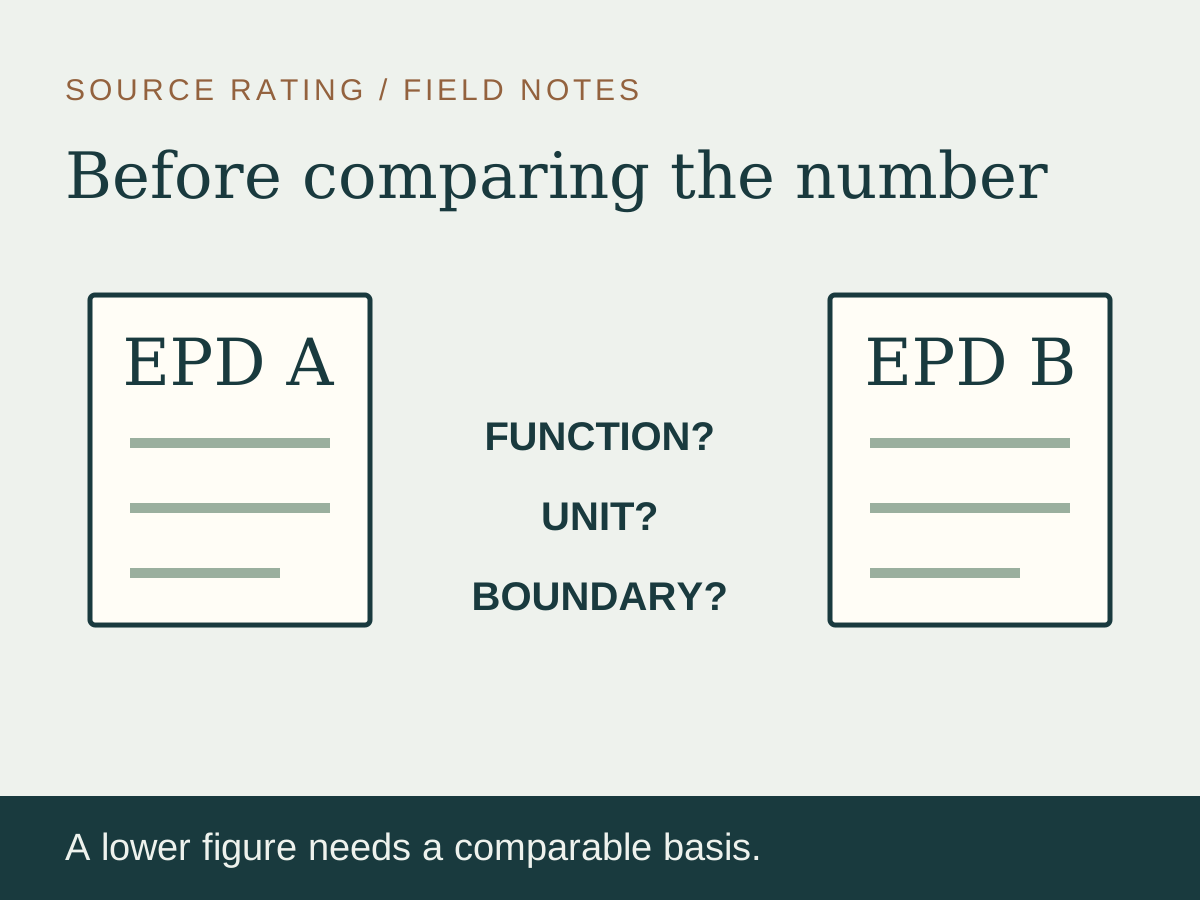
The two bids both include an Environmental Product Declaration. Both display a carbon figure. One is lower. That looks like a useful purchasing advantage—until someone asks what quantity, performance and part of the life cycle each number actually represents.
A smaller number is not yet a better offer. First, make sure the two numbers are answering the same question.
A declaration is not a winner's badge
The International EPD System's official explanation states that an EPD communicates verified environmental information; having one does not establish superiority over alternatives. That distinction is worth preserving in a supplier comparison. The document provides evidence to examine, not an automatic recommendation to buy.
Its Product Category Rules guidance explains that PCRs establish rules for life-cycle assessment and declarations within product categories. They support consistency and comparability. Matching a category label alone, however, is not the same as checking that the two particular declarations support the intended comparison.
The programme's published limitations on comparison identify conditions including aligned PCRs and versions, equivalent function and technical performance, compatible reference units, matched life-cycle coverage and assessment methods, and current validity. The linked record is cited for that published limitation—not as an evaluation of its manufacturer's environmental performance.
The denominator carries a technical assumption
Read the declared or functional unit before copying a result into a spreadsheet. Is the figure attached to a mass, an area, an item or a defined performance? For a buyer comparing alternatives, ask the responsible life-cycle specialist what common basis actually represents the work those products must perform.
Converting a mass unit to an area unit may be arithmetic. Establishing equivalent performance is an engineering question. A tidy conversion does not resolve differences in the specification, required quantity or intended use. Record the assumptions rather than hiding them in a formula that the next reviewer cannot reconstruct.
Then identify which stages the comparison includes. A manufacturing-stage result should not silently become a whole-life claim. Where a stage is outside the declared boundary, do not enter it as zero merely to complete a table. Ask whether additional scenario information is needed for the purchasing decision and who is responsible for supplying it.
Keep the comparison reproducible
A practical bid record should retain the source declaration, its version, the product it covers, the chosen indicator and the reference basis used. Put any conversions and exclusions beside the comparison. Another reviewer should be able to reach the same figures without guessing which PDF page or product variant the purchaser intended.
If the supplier submits an updated declaration or proposes a different product, recheck the comparison rather than replacing only the headline number. Ask what changed in the underlying information and whether the previous assumptions still hold. A new PDF can be an improvement in evidence without being proof of an improvement in the product.
Where the declarations cannot yet be compared fairly, say so. 'Comparison not established on the available basis' is a useful procurement conclusion. It identifies the missing work without accusing either supplier of a false declaration or assigning an unsupported environmental ranking.
This does not make environmental evidence too complicated to use. It makes the first reading more disciplined. Before debating which carbon figure is lower, agree what each figure measures. The denominator, the function and the boundary determine whether there is a comparison to debate at all.
Reading notes
Source notes
Primary programme-operator guidance checked on 21 October 2026. This is a reading and procurement note, not a completed comparative life-cycle assessment, a product endorsement or a reproduction of paid standards.
International EPD System
Distinguishes transparent environmental information from a claim that a product is superior.
EPD International
Explains category-specific assessment rules and the role of PCRs in consistency and comparability.
International EPD System
Only the public programme comparison limitations are used here. The article does not compare, endorse or reproduce this product's numerical results.