Buyer's Field Notes
The Crate Is Plywood. What Are the Skids Made Of?
The label on the quotation may describe the walls of a crate, not everything supporting the cargo. Look underneath before assuming the whole packing arrangement falls outside wood-packaging controls.
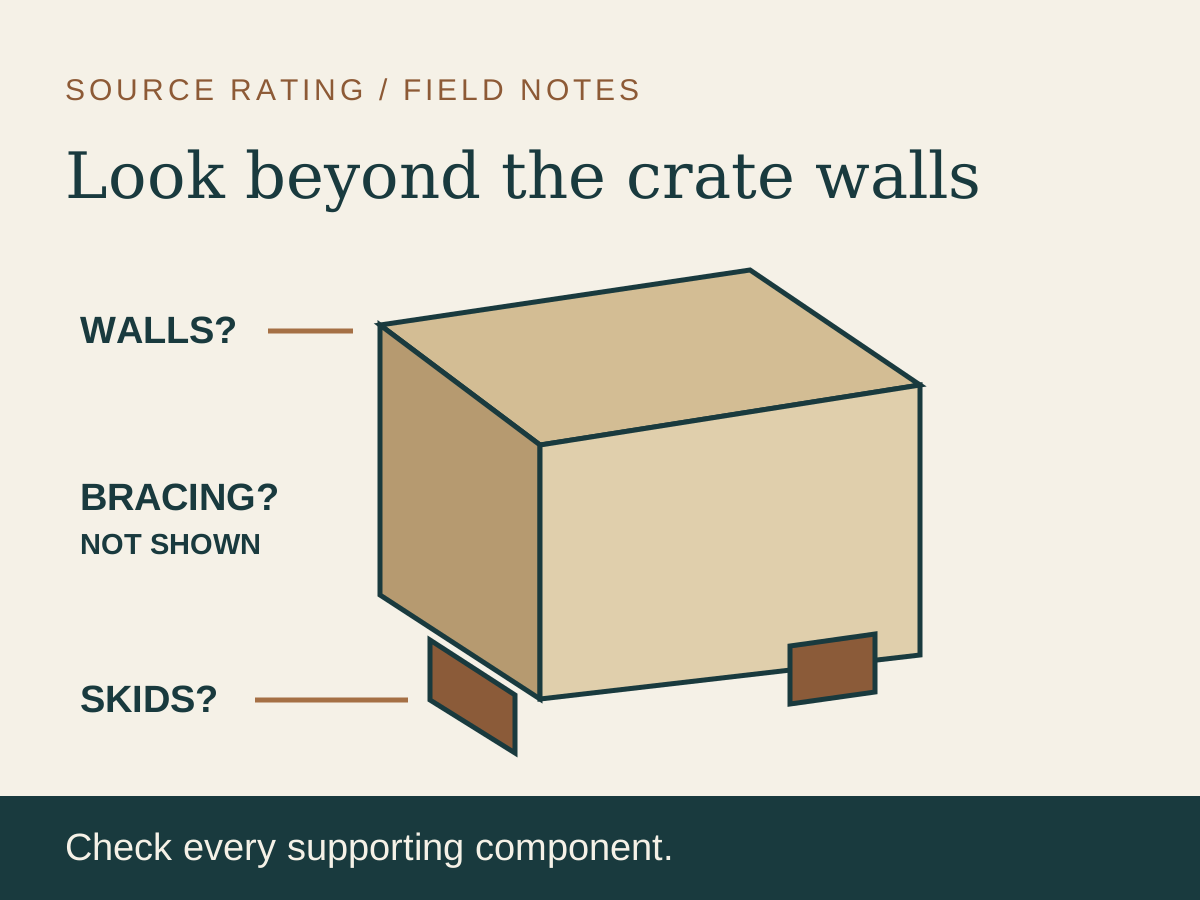
'Plywood case' is a convenient line on an export quotation. It tells a buyer something about the enclosure. It may say nothing about the runners underneath it, the blocks inside it or the timber added when the case is secured in a container.
That gap matters because the packing arrangement is made of components, while the sales description often names only its most visible material.
Check the whole packing arrangement
The IPPC's public description of ISPM 15 says the standard addresses pest risks associated with raw-wood packaging in international trade, including dunnage. It excludes packaging made from wood processed in a way that removes the relevant pest risk, giving plywood as an example. This is not the same as saying that every assembly with plywood walls is wholly processed wood.
For imports into the European Union, the European Commission's wood-packaging guidance explicitly describes the processed-wood exemption in terms of packaging made entirely from such material. It separately addresses wood packaging and dunnage. Those are EU requirements, not a substitute for checking a different destination's plant-health rules.
The buyer's practical question is therefore simple: which materials are actually present? Obtain a packing description that identifies the walls, base, skids, internal supports and any loose bracing. Do not infer a component's material from the name of the complete case.
The final addition can change the answer
A carefully specified case can be only part of the export arrangement. A separate party may add blocks or dunnage during loading. If the supplier's packing declaration stops at the factory gate, ask who checks what is added later. This is a handover question, not a claim about any particular packer.
For components that fall within the applicable controls, arrange the required compliance through authorized providers and verify the relevant marking and documentation with the party responsible for shipment. Do not treat a supplier's generic 'fumigation-free' statement as a component-by-component assessment. Equally, do not order unnecessary treatment of genuinely exempt processed material merely because it looks like wood.
Ask for photographs that show the actual base and any separate bracing before they become inaccessible. The useful photograph is not a handsome closed crate in a catalog. It is an identifiable view of the packing that accompanies this order, with enough context to connect it to the packing list.
Plant-health compliance is not a load rating
Keep the other packing questions separate. Even where the material satisfies the applicable plant-health requirements, the buyer still needs an appropriate design for supporting, handling and protecting the goods. A compliance mark is not, by itself, a statement of lifting capacity or evidence that the case will protect a precision component from moisture or movement.
Conversely, a strong-looking base does not establish that its material satisfies the destination's controls. Assign both responsibilities: the technical packing and handling arrangement, and the applicable plant-health compliance. One should not be assumed from the other.
The IPPC also notes that the measures are not intended to provide continuing protection against later contamination. Keep the final storage and loading condition in view rather than treating an earlier treatment or material declaration as the end of every inspection.
Before approving the packing, replace 'Is it a plywood case?' with 'What is every supporting and securing component made of, and who checks the final arrangement?' That question reaches the parts most likely to be absent from the quotation.
Reading notes
Source notes
Official IPPC and European Commission pages checked on 21 October 2026. The article provides procurement questions, not treatment instructions, destination clearance advice or an engineered packing design.
International Plant Protection Convention
Public scope covers raw wood and dunnage, distinguishes processed packaging and limits what treatment establishes.
European Commission
EU-specific guidance; the processed-wood exemption refers to packaging made entirely from the relevant processed materials. Other destinations require their own check.