Buyer's Field Notes
Your Supplier’s HS Code Is a Starting Point, Not the Import Decision
A tariff number that works on the export side may not exist in the destination's schedule. Ask what the code describes before letting it become an assumption in the landed-cost calculation.
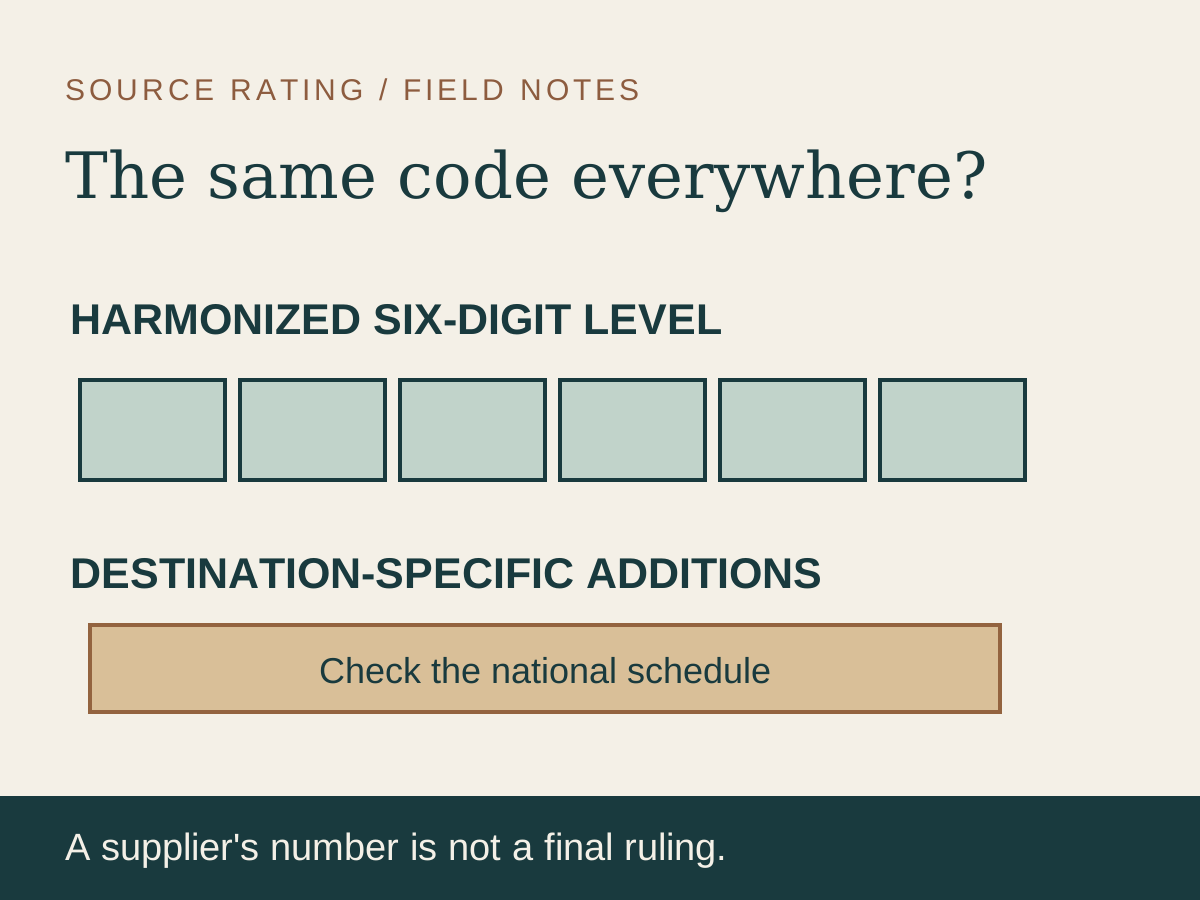
A supplier sends a tariff code with the quotation. It looks precise, the company has exported the product before, and the purchasing spreadsheet needs a number. Copying it into the import-cost model can feel like administrative housekeeping rather than a technical decision.
Then the destination's tariff search returns no exact match. That does not necessarily mean the supplier invented the code. It may mean the buyer copied a national export-side number into a different country's import system.
Shared beginnings do not mean identical endings
The US International Trade Commission addresses this exact question. It explains that the first six digits are harmonized internationally, while further digits and their descriptions can be country-specific. A number supplied from China may therefore be valid there without being the appropriate complete US HTS number. Countries also choose their own duty rates.
The Commission's overview of the Harmonized System describes the hierarchy: chapter, heading and six-digit subheading, followed by national additions. That architecture explains why matching the beginning of two numbers is useful but does not finish the destination classification.
These official explanations use the US system as their example. For another destination, use that jurisdiction's current official schedule and appropriate customs advice. This article is not selecting a code or estimating a rate for any particular shipment.
A product description is the input, not the conclusion
Before asking a broker to confirm the supplier's number, give the broker enough information to assess the actual goods. A trade name alone may be an inadequate instruction. As a practical starting point, assemble the product description, composition, function, relevant drawings and the form in which it will arrive, then ask what further information is needed.
Keep that information consistent across the technical offer and shipping paperwork. If the engineering team describes an assembly while the draft invoice describes only one material, resolve the mismatch before relying on the classification. Do not simplify a description solely because a different category appears cheaper.
Ask the supplier what its proposed code represents and in which country's system it is used. Record the answer as supplier-provided information, not as a binding destination determination. A useful supplier can help explain the goods even when the importing party and its advisers must settle the destination treatment.
Keep the assumption visible until it is checked
In a preliminary comparison, mark an unconfirmed tariff classification as provisional. Record who is checking it and what product information remains missing. This is more honest than presenting a landed-cost total with false precision and quietly changing the underlying code after the purchase decision.
Where the classification is material to the purchase and remains uncertain, ask the destination customs authority or qualified adviser about the appropriate clarification or ruling process. Do not treat a search-engine result, an unrelated importer's code or a previous shipment of a vaguely similar product as an automatic answer.
Once the basis has been confirmed, preserve it with the purchase file and revisit it when the goods or relevant rules change. The record should make clear which product description was assessed and which destination schedule was used. Otherwise an apparently routine reorder can carry forward an assumption nobody remembers making.
The supplier's code is a useful lead. The mistake is allowing that lead to disappear into a spreadsheet as an established fact. Read the description, establish the destination and resolve the uncertainty while there is still time to change the order—not the description of the goods.
Reading notes
Source notes
Official USITC explanations checked on 21 October 2026. No product-specific classification, tariff rate, origin treatment or legal customs advice is provided. Procurement suggestions are clearly separate from the cited system descriptions.
United States International Trade Commission
Explains international six-digit harmonization and national code differences; the source's product example is not used to classify an industrial order.
United States International Trade Commission
Explains chapter, heading, subheading and national additions. Current duty calculations require the applicable destination schedule and facts.