Buyer's Field Notes
The PMI Screen Says 316. Who Verified the L?
A handheld alloy match can be useful without proving the low-carbon requirement. Buyers should ask which elements were actually measured before treating a grade label as full material acceptance.
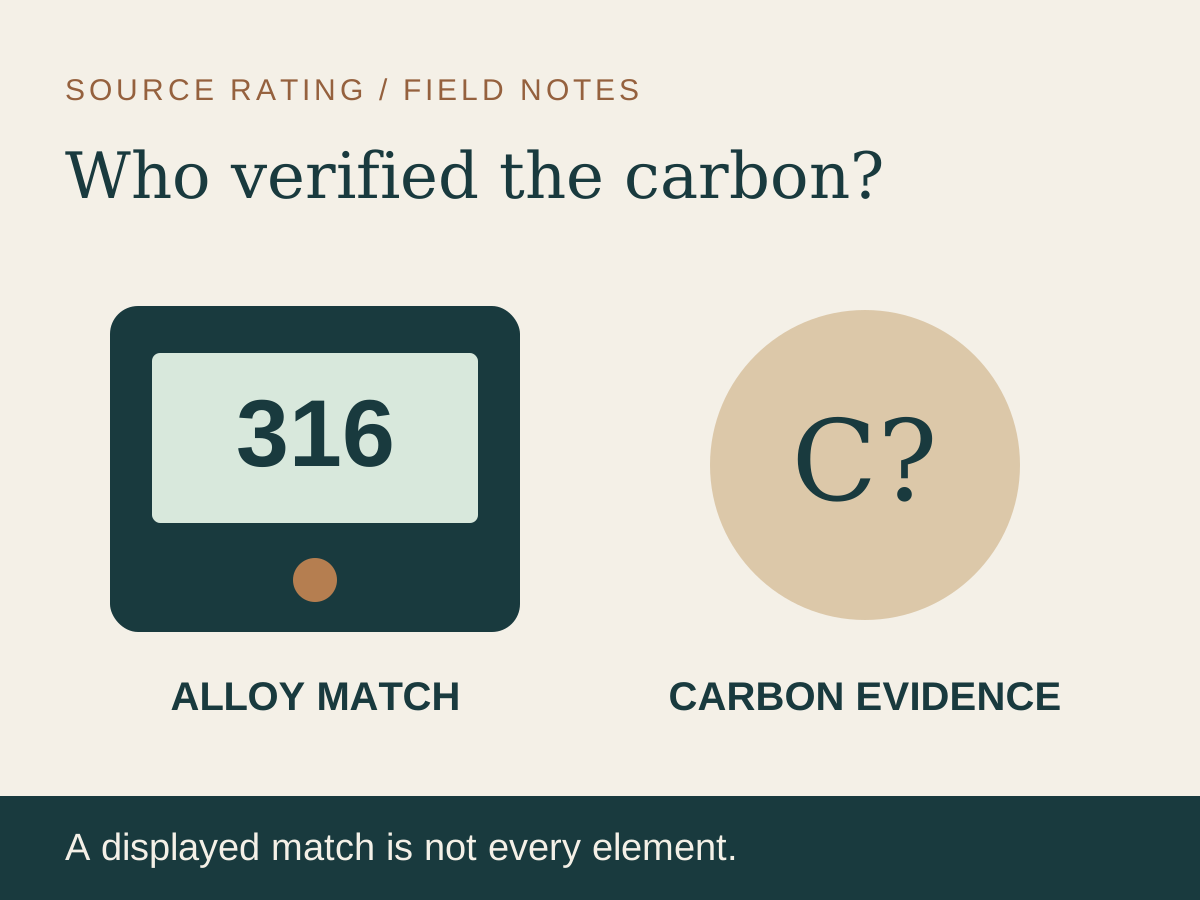
A photograph of a handheld analyzer showing a familiar stainless-steel grade can close a purchasing conversation very quickly. The material has been checked, the screen matches the order, and the photograph goes into the release file.
But a grade name on a screen is not a list of everything the instrument measured. When the order specifies a low-carbon grade such as 316L, that distinction deserves an explicit answer.
The missing element matters
Thermo Fisher Scientific's comparison of handheld XRF and LIBS explains that conventional handheld X-ray fluorescence does not determine carbon. It contrasts that limitation with carbon-capable LIBS and optical-emission approaches. Accordingly, an XRF alloy-family match alone cannot establish the carbon distinction required for an L-grade claim.
That is a limit of what the particular technique establishes, not a reason to discard XRF. A test can be very useful for the elements it measures while leaving a decisive requirement unverified. Nor should a buyer assume that any instrument described as LIBS or OES is automatically suitable: the actual configuration, calibration, method and application still need to match the measurement task.
The manufacturer's article is technical application guidance from an instrument supplier, not an independent approval of a purchasing specification. The useful conclusion is narrower than a product recommendation: select evidence capable of answering the element-specific question.
Ask for the measured chemistry, not just the label
Request the analytical result behind the displayed match, the method used and the identity of the tested piece. Put that beside the ordered product standard and grade. Which required characteristics were measured, which came from the mill certificate, and which were not checked by this inspection? A short coverage statement can prevent a surprisingly large misunderstanding.
A heat-specific material certificate may contain carbon information that the handheld test cannot provide. Its usefulness still depends on connecting the certificate to the supplied material. If a plate has been cut into blanks or stock has been split into several packages, the buyer needs the preserved identification trail—not simply a certificate for a plausible heat of the same alloy.
Where the contract requires additional product analysis, ask the responsible material specialist to specify an appropriate method and acceptance basis. Do not quietly replace a required carbon determination with a convenient alloy-screening photograph. Equally, do not demand destructive retesting of every component when the agreed inspection plan does not call for it.
A chemical check is not the whole material decision
Keep the release record explicit about coverage. An elemental analysis does not, by itself, answer whether the part has the ordered dimensions, processing history or required mechanical-test evidence. These are separate contractual questions. The supplier should not have to guess which one the buyer believes was settled by the PMI record.
A useful request is: 'Please identify the chemical requirements checked by this method, the evidence supporting the carbon requirement, and the piece-to-heat connection for the released material.' That wording is a suggested procurement question, not a replacement for a technical inspection procedure.
When a record is incomplete, call it incomplete. A missing carbon determination is not proof that the steel contains too much carbon. It is a missing piece of evidence. Keeping that distinction clear avoids both unsupported rejection and an unsupported pass.
The next time a grade label appears on a screen, look past the match and ask what was actually measured. The letter that matters most on the purchase order may be the one the instrument cannot establish.
The companion guide to mill certificates and heat-number traceability follows the material identity through fabrication and shipment.
Reading notes
Source notes
Primary instrument-manufacturer guidance checked on 21 October 2026. No universal chemistry limits, testing settings or instrument purchase recommendation are supplied; use the applicable product specification and a qualified measurement procedure.
Thermo Fisher Scientific
Manufacturer-authored explanation of elemental capabilities and carbon-sensitive grade verification. It is cited for the method limitation, not as proof of any actual supplied steel.