Buyer's Field Notes
An Accredited Laboratory Can Still Be the Wrong Laboratory for Your Test
The logo on the report is not the end of the enquiry. The useful question is whether the laboratory's accredited scope covers the particular work your purchase requires.
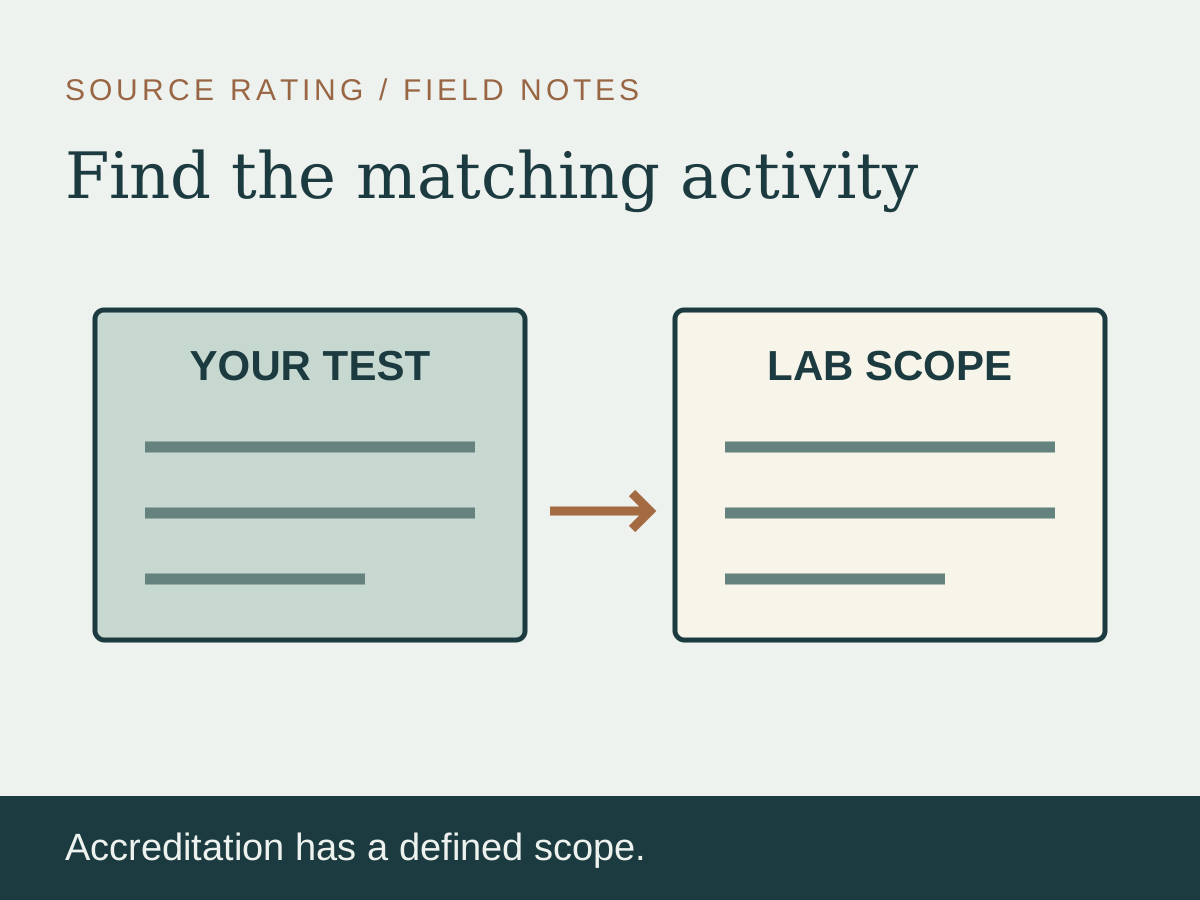
The buyer asked for an accredited test report. The supplier sent a laboratory brochure, a certificate and a polished result sheet. The package looks complete. Yet one document may still be missing: the scope that connects the laboratory's accreditation to the actual test being ordered.
This is not a reason to distrust accredited laboratories. It is a reason to use accreditation for the specific assurance it provides, rather than stretch it into a claim about everything a laboratory might offer.
The scope is part of the evidence
NIST's explanation of its NVLAP program describes accreditation as recognition of competence to carry out specific tests or calibrations. It is formalized through both a certificate and a scope. NIST also distinguishes that finding of competence from certification of a product or a guarantee of particular test data.
Its accreditation-versus-certification explanation makes the practical distinction clear: the scope lists the methods or calibration parameters covered. These are explanations of the US NVLAP scheme, not a statement that every overseas laboratory must belong to it. For another accreditation body, verify the corresponding current scope through that body's own records.
A buyer should therefore put the required test and the scope side by side. Match the method, relevant product or material, and any stated limits or conditions. If an apparent mismatch has a legitimate explanation, obtain it from the laboratory or accreditation body. Do not infer an extension merely because two methods sound similar.
An order for testing is a technical instruction
Before sending samples, state what decision the report must support. Is the purpose to characterize a material, compare a supplier's claim, demonstrate compliance with a particular project requirement, or investigate a defect? Those are different assignments, even when the sample looks identical.
Ask the laboratory to identify which ordered activities will be reported as accredited work. Clarify any work performed outside that scope or subcontracted elsewhere, and how it will be identified in the final report. This is suggested purchasing practice; it is not a claim that unaccredited work is necessarily incompetent or prohibited.
Also agree what the sample represents. A laboratory may accurately test the item it received without knowing whether the supplier selected it from the production lot being shipped. Sampling, sample identity and the laboratory's analytical competence are separate links. Where representation matters, assign responsibility for selection and record the connection to the purchase.
Do not ask the accreditation mark to approve the project
A technically competent test does not settle every question of use. The project's responsible designer or approving authority may still need to decide whether the method, specimen configuration and result satisfy the governing requirement. It is better to resolve that acceptance route before commissioning a report than to ask for a replacement stamp after the first report is rejected.
Keep a short explanation in the purchase record: this laboratory, this current scope, this ordered method, this identified sample, and this intended decision. The explanation need not be a long checklist. It should be clear enough that another engineer can see why the report is relevant without relying on the supplier's assurance that the laboratory is well known.
The wrong response to an unclear scope is either automatic rejection or automatic acceptance. Ask the narrow question, obtain the missing connection and record the answer. Accreditation is most useful when its boundary stays visible.
For a related release issue, see what acceptance sampling says about the shipment.
Reading notes
Source notes
Official NIST explanations checked on 21 October 2026. NVLAP is used to explain the distinction between defined competence and product approval, not presented as the mandatory scheme for every jurisdiction.
National Institute of Standards and Technology
Explains recognition of competence for specific work and the certificate/scope distinction; accreditation is not product certification.
National Institute of Standards and Technology
Explains the role of listed test methods and calibration parameters. This article does not rely on historical membership counts or an assumed universal acceptance arrangement.