Buyer's Field Notes
A Thousand Hours in Salt Spray Is Not a Thousand Hours at Your Site
A long laboratory exposure can be useful evidence. Turning it into a promise of outdoor life requires a different argument—and a much more specific description of what was tested.
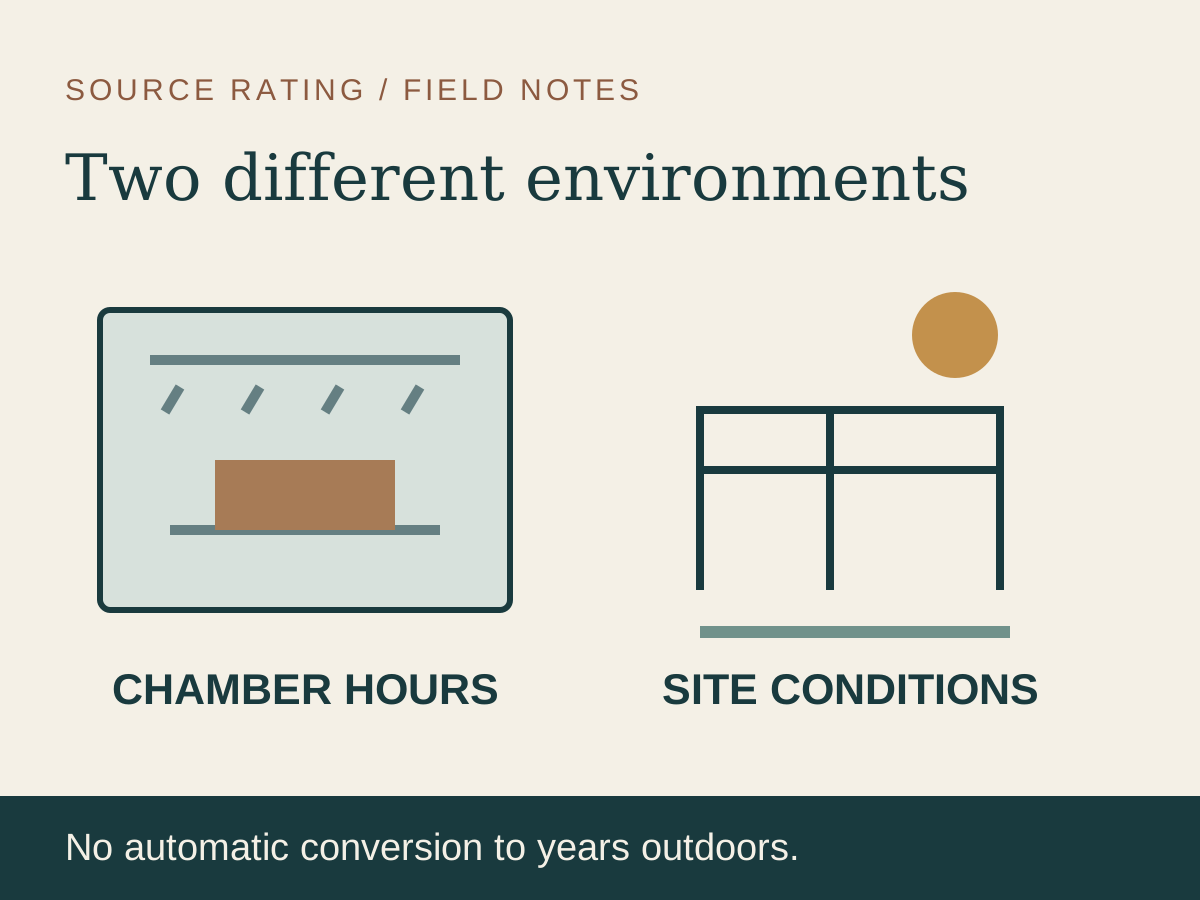
A coating quotation advertises a large number of salt-spray hours. The next quotation advertises an even larger one. It is tempting to rank the two offers by that number and assume that the second coating will last longer on the project.
The ranking may be premature. Before comparing the hours, compare the specimens, the exposure method and the definition of failure. Then ask a separate question: what connects either laboratory result to the conditions in which the product will actually be used?
What the chamber can—and cannot—tell you
The public scope and significance notes for ASTM B117 describe a controlled corrosive environment for obtaining relative corrosion-resistance information. They also caution against predicting natural exposure performance from salt-spray results alone. The practice does not choose the product's exposure duration, specimen or interpretation for the purchaser.
That leaves a considerable amount of work outside the standard number printed on a sales sheet. 'Tested to B117' is not a complete acceptance criterion, and a stated number of hours is not, by itself, a service-life estimate. A project specification may legitimately require a particular exposure and result; that does not make it a universal conversion formula for years outdoors.
The American Galvanizers Association's explanation provides a specific warning for galvanized steel: continuous salt-spray exposure does not reproduce the ordinary development of the protective surface products that matter in atmospheric service. This is a reason to understand the coating mechanism, not a claim that every accelerated test is useless or that galvanizing is always the right coating.
Read the report behind the headline number
Ask which substrate and coating system were tested, how the specimen was prepared and whether its thickness and treatment represent the quoted production process. Was the result obtained on a flat laboratory panel or on a component with the details that concern your order? Keep the specimen description beside the result instead of filing it several pages away.
Next, identify what 'passed' means in the report. Which appearance or corrosion criterion was assessed, on which area, and after what exposure? If one offer counts a particular defect as failure and the other does not, identical hour totals would still not establish equivalent performance. These are questions to settle with the competent testing and coating specialists, not values to infer from a brochure.
The report's age matters for a different reason from its expiry date. Ask whether the current coating, pretreatment, substrate and application process still match the tested configuration. A genuine report for a previous system is not automatically evidence for the replacement system merely because the commercial product name stayed the same.
Put the service question back into the RFQ
Describe the intended environment and maintenance assumptions to the supplier and the responsible coating professional. Relevant project questions may include wetting and drying, contamination, contact conditions, abrasion, cleaning and access for maintenance. This article is not assigning an exposure category or specifying a protective system; those judgments require the actual application.
Request two separate explanations: evidence that the offered system meets the specified laboratory acceptance requirement, and the basis for any claimed performance in service. If the second answer is an estimate, record its assumptions and limitations as an estimate. Do not silently promote the first answer into the second.
A useful comparison is therefore not 'more hours wins.' It is 'comparable test, relevant specimen, defined criterion, and a credible connection to the application.' That may take one additional technical exchange before award. It is considerably more useful than discovering after installation that everyone had attached a different meaning to the same impressive number.
For batch identity and release evidence on fabricated galvanized steel, see which pieces the coating inspection actually represents.
Reading notes
Source notes
Public ASTM scope and industry-association guidance checked on 21 October 2026. No purchased standard tables, test operating instructions or generic hours-to-years conversion are reproduced.
ASTM International
Public scope and significance identify what the practice controls and the limitations of standalone extrapolation.
American Galvanizers Association
Industry explanation of a particular mismatch between continuous salt-spray exposure and atmospheric behavior of galvanized zinc. Not an endorsement of every coating claim.